Key Takeaways: Sleep Tracking Without a Wearable: How Radar and Under-Mattress Sensors Work
- Contactless trackers mostly fall into two families.
- What they can and cannot measure.
- Because these devices sit in the most intimate room in your home and collect nightly health data, it is worth knowing where that data goes.
Table of Contents
- Two main ways to track sleep without wearing anything
- What they can and cannot measure
- Contactless versus a wearable: the trade-offs
- The privacy angle
- Who should consider one
- A note on what actually improves sleep
- How accurate is it, really?
- The new wave of products
- Getting the cost-to-value balance right
- Sources and further reading
Sleep tracking used to mean strapping something to your wrist or slipping on a ring and remembering to charge it. A growing class of devices removes all of that. Bedside radar units, under-mattress pads and even smart lamps now claim to track your sleep with nothing on your body at all. For people who find a band or ring uncomfortable, or who simply forget to charge them, the appeal is obvious: you lie down and the room does the work.
This article is general information about consumer health technology, not informational context. Speak with a qualified professional about your own health.
Two main ways to track sleep without wearing anything
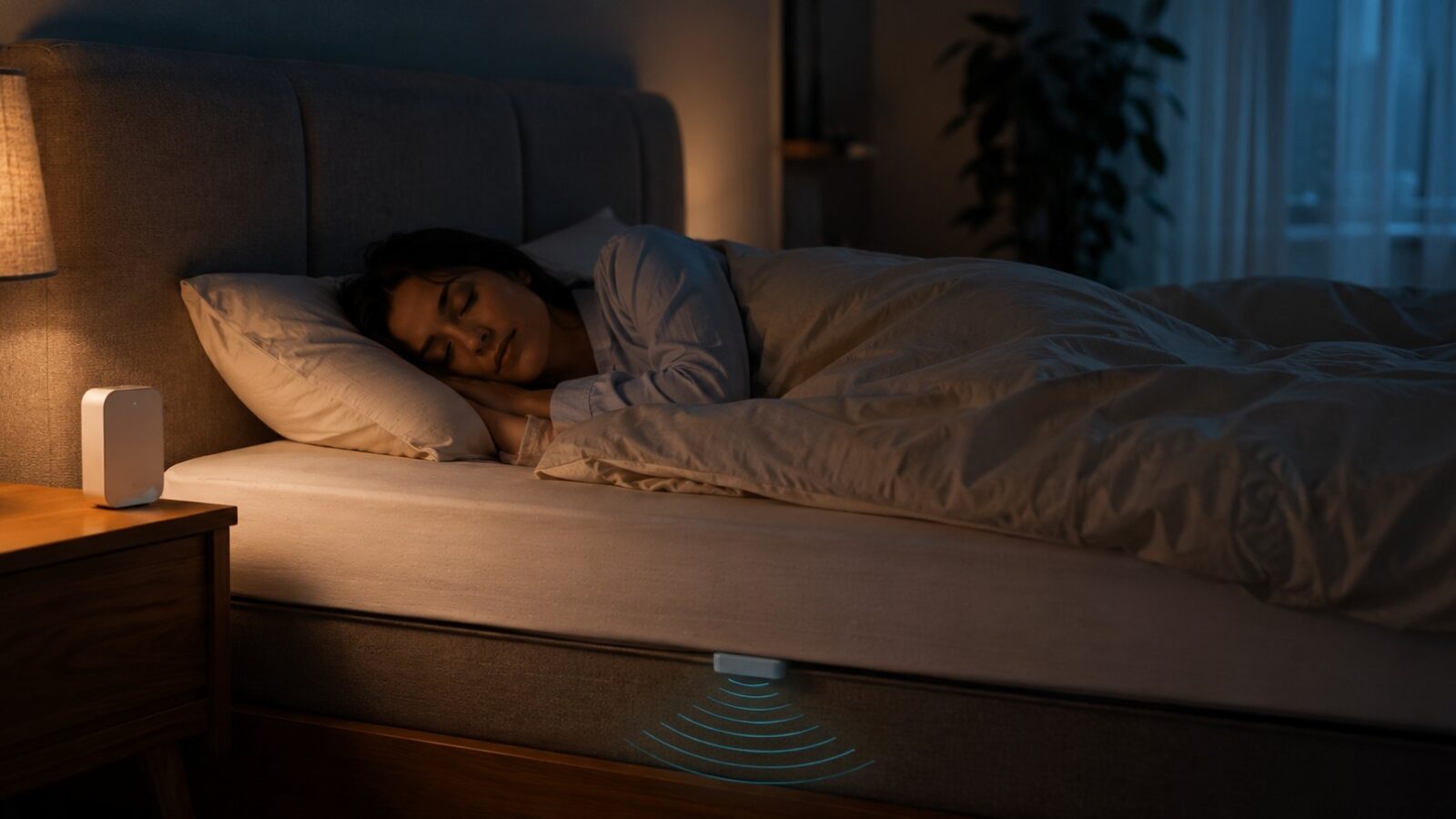
Contactless trackers mostly fall into two families. The first is under-mattress sensors, which use a technique called ballistocardiography: a thin strip beneath the mattress detects the tiny mechanical waves your heartbeat and breathing send through the bed. The second is bedside radar, where a small device emits imperceptible radio waves and reads the reflections from your chest rising and falling. Some popular smart displays have quietly included this radar sensing for years, and newer products fold it into lamps that combine sensing with a sunrise alarm, a cousin of the devices in smart alarm clocks and sunrise lamps.
What they can and cannot measure
These systems are good at the basics: when you fell asleep, how long you slept, how often you stirred, and your breathing and movement through the night. What they cannot do is touch your skin, so they infer sleep stages from movement and breathing rather than measuring heart rate variability directly. That matters because, in validation research, contactless and under-mattress devices tend to struggle most with distinguishing deep sleep, the very stage people most want to know about. The honest expectation matches what we say about wrist-based tracking in how accurate sleep tracking really is: useful for trends and totals, weaker on precise stage-by-stage detail.
Contactless versus a wearable: the trade-offs
- Comfort and consistency: nothing to wear or charge, so coverage is effortless and complete night to night.
- No daytime data: a bedside or under-mattress sensor only knows about the bed, unlike a watch or ring that tracks activity around the clock.
- Whose sleep is it: a bed shared with a partner or a restless pet can confuse some sensors about who is being measured.
- Accuracy ceiling: none of these consumer methods matches a clinical sleep study, and deep-sleep estimates in particular are approximate.
The privacy angle
Because these devices sit in the most intimate room in your home and collect nightly health data, it is worth knowing where that data goes. Radar and pressure sensing are not cameras, which is reassuring, but the breathing, heart-rate and movement records still count as sensitive health information. Check whether data is stored locally or in the cloud, whether you can delete it, and what the company does with it, the same diligence we recommend in the health app privacy checklist.
Who should consider one
Contactless tracking suits people who want a frictionless picture of their sleep trends, who dislike wearing devices, or who have sensory sensitivities that make a band or ring unpleasant. It is also appealing for keeping a gentle eye on an older relative’s rest without asking them to wear anything. If you want all-day metrics and recovery data, a wearable still does more; if you mainly want to understand your nights without homework, a contactless device can be the better fit. A practical middle path many people land on is a quality mattress plus a modest under-mattress sensor, which delivers most of the benefit of pricier all-in-one smart beds for a fraction of the cost.
A note on what actually improves sleep
Whichever route you choose, remember the tracker only measures; it does not fix anything. The improvements that move the needle, consistent timing, a cool dark room, limiting evening screens and alcohol, are the same ones covered in a bedroom technology audit. And if a device repeatedly flags heavy snoring, long pauses in breathing or unrefreshing sleep despite enough hours, that is a reason to see a clinician rather than to buy another gadget, as we discuss in sleep apnea tracking at home.
How accurate is it, really?
Validation studies give a consistent picture: contactless trackers are reasonably good at the big-picture numbers, total sleep time, time to fall asleep, major awakenings, and weaker at fine-grained sleep staging, especially deep sleep, because they infer it from movement and breathing rather than measuring brain activity. Under-mattress sensors using ballistocardiography and bedside radar both face this limit, as the sensor sits at some distance from the body. Smartphone apps that use sonar (inaudible sound bounced off your chest) have performed surprisingly respectably in some testing, while apps relying only on a phone’s motion sensor tend to be the weakest. None approaches the accuracy of a clinical sleep study, which remains the reference for identifying patterns in sleep disorders.
The new wave of products
The category is expanding quickly. Beyond the familiar smart displays that quietly include radar sensing, makers are now building millimetre-wave radar into bedside lamps that double as sunrise alarms, and under-sheet pads that report stages, heart rate and breathing with no monthly fee. Smart mattresses go further, embedding sensors and adding active temperature control, though at a far higher price. The non-wearable sleep-tracker market is forecast to grow strongly through the early 2030s as smart-home integration deepens, which means more choice but also more first-generation products whose real-world accuracy is not yet proven, so waiting for independent reviews of a brand-new device is sensible.
Getting the cost-to-value balance right
If you are tempted by an all-in-one smart bed, it is worth knowing that a quality conventional mattress paired with a modest under-mattress sensor delivers much of the same tracking benefit for a fraction of the cost, without locking you into a subscription-dependent ecosystem. Spend on the surface you actually sleep on first; manage the sensor as an optional, inexpensive add-on. That ordering tends to serve sleep better than buying the most feature-laden device and hoping the data alone improves your nights.