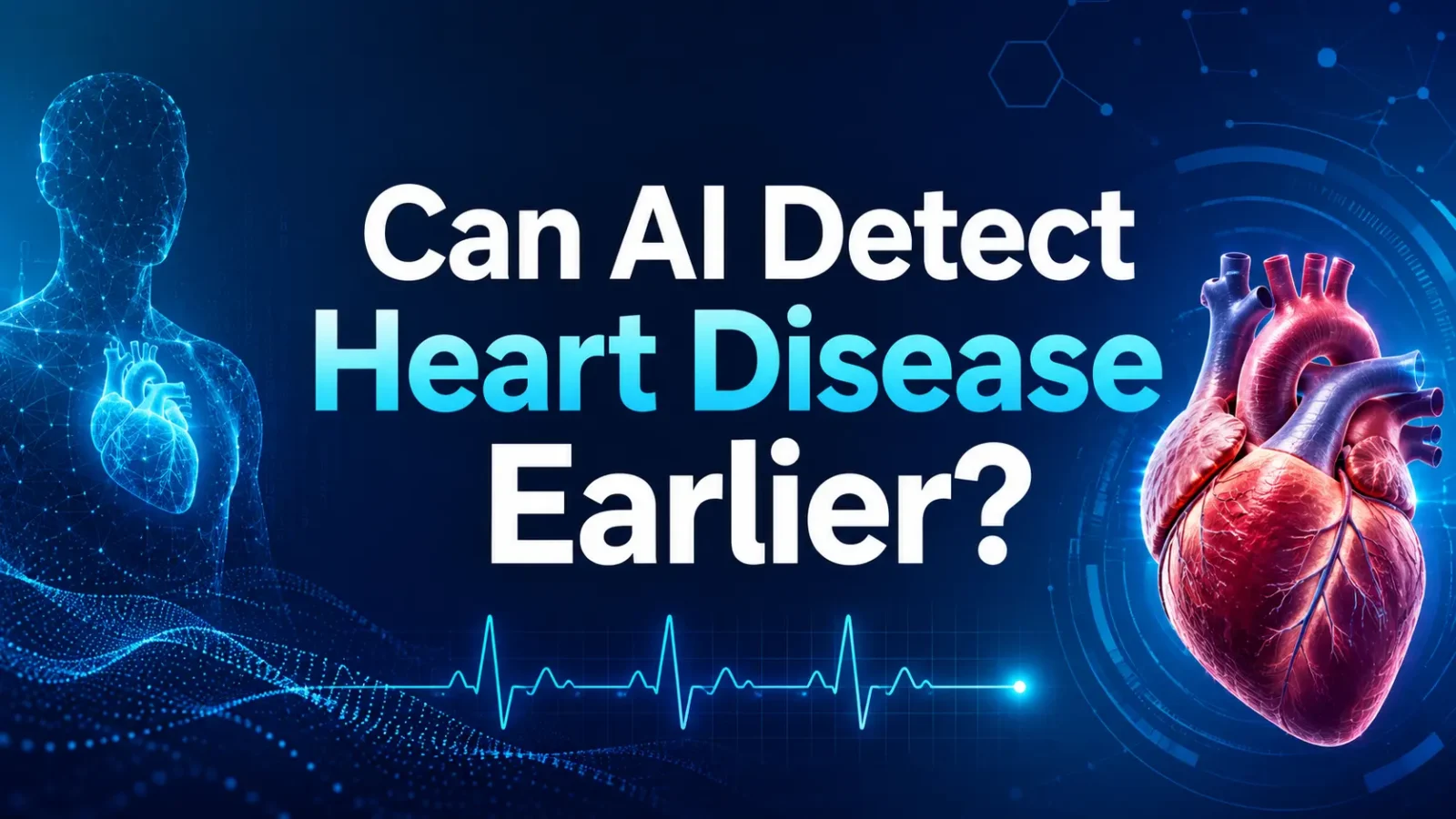
Key Takeaways: Can AI Help Detect Heart Disease Earlier?
- Cardiology is one of the major areas represented in AI-enabled medical devices.
- A risk score can identify someone who may benefit from further assessment, but it does not automatically improve health.
- Finding a problem sooner is valuable when earlier action improves the outcome.
Table of Contents
- Algorithms are strongest when the input is reliable
- Screening is useful only when the next step is clear
- Earlier is not always better without a proven benefit
- Early detection can mean several different things
- Where patients may encounter these systems
- What a promising study still cannot prove
- Heart data should not be treated like ordinary account data
- Useful questions, without the sales language
- False reassurance and unnecessary alarms both cause harm
- Earlier detection is useful only when the next step is clear
- Earlier is valuable only when it improves care
- What earlier detection must prove
AI can help detect some heart risks earlier, but it does not work like a crystal ball. The most promising tools analyze ECG patterns, echocardiograms, CT scans, retinal images or electronic health records to identify signals that may be difficult for humans to notice quickly. The best systems support clinicians. They do not replace careful history, examination and judgement.
Consumer technology related to AI heart disease detection can add useful context, but it has limits. Seek qualified help when symptoms are severe, persistent or inconsistent with the information shown by the product.
The strongest case for AI heart disease detection is usually modest: better records, clearer patterns and more focused conversations. Claims about cardiac risk prediction or ECG analysis should still be checked against evidence and intended use.
Algorithms are strongest when the input is reliable
Cardiology is one of the major areas represented in AI-enabled medical devices. Some tools analyze rhythm, others measure heart structure, and others support imaging interpretation. A model that performs well in a study still needs real-world validation, because age, sex, ethnicity, equipment and local workflows can influence performance.
Screening is useful only when the next step is clear
A risk score can identify someone who may benefit from further assessment, but it does not automatically improve health. The system needs a defined threshold, an appropriate confirmatory test and a care team able to respond. Without that pathway, a prediction may create anxiety or sit unnoticed in a dashboard.
Heart disease also includes many different conditions. A tool designed to identify an irregular rhythm should not be described as though it detects blocked arteries, heart failure and every future event. Readers should look for the exact condition, population and clinical setting studied.
- Ask what condition the model is designed to detect.
- Check whether the tool is for screening, triage or diagnosis.
- Do not delay urgent care because an app shows a low risk score.
- Expect a clinician to consider symptoms, history and conventional tests.
Earlier is not always better without a proven benefit
Finding a problem sooner is valuable when earlier action improves the outcome. Screening can also produce incidental findings, repeat tests and anxiety. The evidence should show more than detection; it should support a useful care pathway.
This is why broad claims about identifying heart disease early need careful reading. The exact condition, test and population determine whether the result can help.
Early detection can mean several different things
Heart disease often develops silently. Earlier detection can lead to lifestyle changes, medication, imaging or specialist care before a serious event occurs. AI may help by triaging scans, highlighting abnormal patterns and estimating risk in large patient groups. The challenge is making sure the tool works for diverse populations and does not create unnecessary alarm.
Where patients may encounter these systems
AI heart tools are most valuable when they reduce delay. They may flag an ECG for review, prioritize a scan or identify people who need more testing. For consumers, the foundation remains blood pressure control, cholesterol management, exercise, smoking avoidance, diabetes care and timely medical review of symptoms.
What a promising study still cannot prove
- Ask whether the AI is part of a regulated clinical workflow.
- Check if a cardiologist or qualified clinician reviews the result.
- Understand whether the tool screens, diagnoses or prioritizes care.
- Look for validation in populations similar to yours.
- Do not ignore symptoms such as chest pain or breathlessness because an app looks normal.
Heart data should not be treated like ordinary account data
Privacy should be part of the decision about AI heart disease detection, not a setting reviewed months later. Check export, deletion, breach notification and support contacts before storing information about cardiac risk prediction or ECG analysis.
Useful questions, without the sales language
Can a phone app rule out a heart problem?
No. Consumer tools may support awareness, but they cannot safely rule out serious disease in a person with concerning symptoms.
What makes a heart prediction trustworthy?
Relevant validation, a clearly defined use, representative data, clinical oversight and a sensible next step after an alert.
False reassurance and unnecessary alarms both cause harm
- Confusing wellness heart age scores with medical diagnosis.
- Assuming AI can predict every heart attack.
- Skipping routine blood pressure, cholesterol and diabetes screening.
- Using smartwatch data without clinician context.
- Ignoring family history because a risk score seems low.
Earlier detection is useful only when the next step is clear
A risk score can identify people who may need closer evaluation, but the benefit depends on access to confirmatory testing and management. Screening more people also creates false positives and incidental findings, which can lead to anxiety and additional procedures.
Consumers should be cautious when a general wellness service claims to predict heart disease without explaining the population, data source, intended use and clinical pathway. A model’s performance in one setting may not transfer to another.
Earlier is valuable only when it improves care
Algorithms may help clinicians notice patterns earlier, especially in ECGs, imaging and large records. The meaningful test is whether the system leads to timely, appropriate care without creating avoidable harm.
What earlier detection would have to prove
Detecting something earlier is only a benefit if acting earlier changes the outcome, and that is a separate question from whether the algorithm can spot a pattern. A model that identifies a subtle signal years before symptoms is an impressive piece of engineering. Whether it helps depends on whether there is an intervention that works at that stage, and whether the people flagged actually benefit rather than being drawn into tests and treatments they did not need.
That is why the regulatory record matters more than the accuracy headline. The FDA’s material on artificial intelligence and machine learning in software as a medical device sets out how these tools are reviewed and what an authorisation covers, and its guidance on how to study and market a device explains the evidence a claim has to rest on. An authorisation is specific to a finding, a modality and a population.
The consumer-facing end of this field has a clearer cautionary record. The American Heart Association’s 2025 statement on cuffless blood pressure wearables found that many have not been proven accurate for real-world use and that commercialisation has run ahead of validation. The FDA has separately warned people not to use smartwatches or smart rings claiming to measure blood glucose, because no such device has been authorised. Both are useful calibration for how much weight to give a wrist-based cardiac risk score.
The realistic near-term picture is less dramatic than the coverage. Algorithms that flag a rhythm irregularity for a clinician to review, or that triage imaging worklists so the urgent scan is read first, are already useful. A device that tells a healthy person they will have a heart attack in five years is a much larger claim, and it needs outcome evidence rather than pattern-matching accuracy.
Sources and further reading
- FDA: artificial intelligence and machine learning in software as a medical device
- FDA: how to study and market your device
- American Heart Association: cuffless blood pressure wearables show promise but are not yet validated
- FDA safety communication: do not use smartwatches or smart rings to measure blood glucose