Key Takeaways: Wearable ECG Alerts: What They Mean and When to Follow Up
- Wearable ECG features are most useful when they are cleared for a specific rhythm assessment and when the user records during symptoms.
- Palpitations without other symptoms may be suitable for routine review, while palpitations with fainting, chest pain or severe breathlessness can require urgent assessment.
- Heart rhythm alerts have helped some people discover atrial fibrillation earlier than they otherwise would have.
Table of Contents
- An alert is a clue, not a complete diagnosis
- Symptoms decide the urgency
- What the watch is recording
- Reasons a tracing may look unusual
- Keep the tracing and the story together
- When symptoms matter more than the screen
- Capture context when the reading happens
- ECG files are sensitive health records
- An alert is information, not a diagnosis
- Save the context around an alert
- When the technology may add more noise than value
- What a single lead can see
A wearable ECG can be reassuring, useful and occasionally important. It can also create confusion when users manage a watch as if it were a hospital ECG machine. Most wrist devices record a single electrical view of the heart. A clinical ECG records twelve views. That single difference explains why a watch may detect possible atrial fibrillation but cannot rule out every heart problem.
Keep the role of the technology in perspective. Information about wearable ECG alert can support better questions, but urgent symptoms and management decisions require suitable professional care.
Wearable ecg alert sits between consumer technology and health decision-making. That makes single-lead ECG, irregular rhythm notification and clear follow-up more important than novelty.
An alert is a clue, not a complete diagnosis
Wearable ECG features are most useful when they are cleared for a specific rhythm assessment and when the user records during symptoms. They are less useful as a general heart health certificate. Palpitations, fainting, chest pain, shortness of breath or neurological symptoms deserve medical attention even if a watch says the rhythm is normal.
Symptoms decide the urgency
Palpitations without other symptoms may be suitable for routine review, while palpitations with fainting, chest pain or severe breathlessness can require urgent assessment. The watch cannot determine that urgency on its own.
If alerts are frequent, ask a clinician how many examples are useful. Sending dozens of similar traces may make review harder, while a few clear recordings with notes can provide better context.
What the watch is recording
Heart rhythm alerts have helped some people discover atrial fibrillation earlier than they otherwise would have. Earlier discussion can reduce risk when the finding is confirmed and treated properly. At the same time, low-risk users can receive false alarms, poor-quality recordings or anxiety-producing notifications that turn normal variation into worry.
Reasons a tracing may look unusual
- Assuming no AFib notification means no heart issue.
- Using a smartwatch ECG to adjust medication.
- Ignoring symptoms because the recording says inconclusive.
- Checking rhythm repeatedly out of anxiety.
- Buying a device only for ECG without considering comfort and battery life.
Keep the tracing and the story together
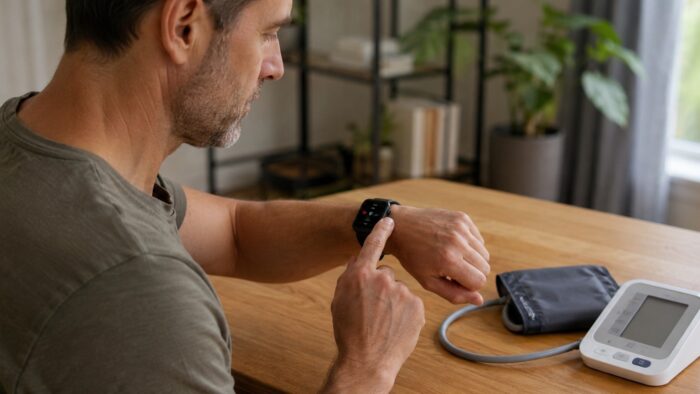
When an alert appears, save the tracing if the device allows it and note what was happening. Record symptoms, activity, caffeine, illness and the approximate time. That context can help a clinician decide whether the result is likely to be useful or whether another type of monitoring is needed.
A wearable may miss a rhythm problem because it was not being worn, the episode was brief or the sensor could not obtain a clean signal. It may also create false alarms from movement or poor contact. Repeated alerts deserve review, but a normal result should never be used to dismiss chest pain, fainting or severe breathlessness.
- Sit still and follow the device instructions for a cleaner recording.
- Do not change heart medication based on a watch result.
- Export the original file rather than only sharing a screenshot.
- Use urgent services for severe or sudden symptoms.
When symptoms matter more than the screen
The healthiest way to use wearable ECG is as a capture tool. If symptoms come and go, the device may record evidence that helps a clinician. It should not become a source of constant self-surveillance. People with known heart conditions should ask their clinician how to use the data and when to report alerts.
Capture context when the reading happens
- Use the ECG feature exactly as instructed and keep the arm still.
- Save the PDF or recording to show a clinician.
- Repeat a poor-quality recording before panicking.
- Know which rhythm the device is designed to identify.
- Seek urgent help for severe symptoms rather than waiting for an app interpretation.
ECG files are sensitive health records
Use the minimum permissions needed for wearable ECG alert. Review access to single-lead ECG, irregular rhythm notification, family sharing and cloud backups, then remove any connection that no longer supports a clear purpose.
An alert is information, not a diagnosis
Wearable ECG can be valuable for capturing a rhythm at the moment it occurs. Its strength is documentation and timing, while interpretation and management decisions still belong in appropriate clinical care.
Save the context around an alert
If a wearable records an ECG or irregular-rhythm alert, note the time, symptoms, activity, recent illness, caffeine, alcohol and whether the strap or finger contact was secure. The context can help a clinician decide whether the recording is useful.
A normal wearable result does not exclude every rhythm problem, and an unreadable trace is not proof of disease. Severe symptoms such as chest pain, fainting or marked shortness of breath need urgent assessment regardless of what the device displays.
When the technology may add more noise than value
Some readers will benefit from structured information about single-lead ECG, while others may become preoccupied with irregular rhythm notification. Notice whether the tool improves understanding or encourages repeated checking without a decision.
Set a review date. At that point, ask whether atrial fibrillation screening has become easier to understand and whether false positive has improved. Keeping a technology indefinitely should be a choice, not the default.
What a single lead can and cannot see
A clinical electrocardiogram uses twelve leads placed around the torso and limbs, which is what lets a cardiologist localise a problem to a region of the heart. A watch or a ring takes a single lead between two electrodes, usually your wrist and the finger of the other hand. That is enough to see the rhythm, and it is not enough to see most other things.
This is why the cleared use case is narrow and specific: detecting an irregular rhythm consistent with atrial fibrillation in people who have not been diagnosed with it, and giving a trace a clinician can look at later. It is not cleared to rule out a heart attack, to assess chest pain, or to tell you your heart is fine. The FDA describes how device claims of this kind are studied and marketed, and the gap between a wellness feature and a cleared function is exactly where most consumer confusion lives.
Two practical accuracy points. The reading depends on skin contact and stillness, which is the same constraint that affects optical sensors: a 2025 PLOS ONE validation study of wrist heart rate found error grew with movement intensity and varied by skin tone. And an inconclusive result is common rather than a malfunction, often caused by a loose fit, dry skin, tremor or arm movement during the recording.
The most useful thing about the feature is not the automated verdict, it is the saved trace. Intermittent arrhythmia is hard to catch in a clinic because it rarely happens while you are there. A dated recording taken during symptoms is real information to bring to an appointment, which is a very different claim from the watch making the call.